
“O Divine Master,
Grant that I may not so much seek
To be consoled as to console;
To be understood, as to understand;
To be loved, as to love;
For it is in giving that we receive,
It is in pardoning that we are pardoned,…”
There are some lessons we don’t realize we’re learning until we’re sitting in the middle of them.
This was one of those lessons for me.
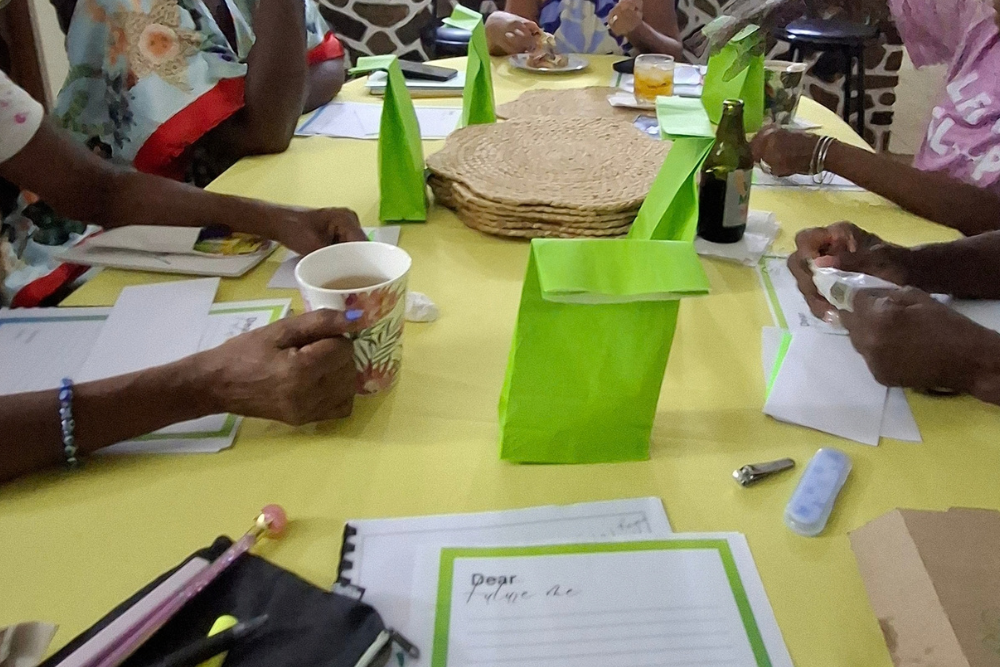
Recently, I was away on retreat with a small group of women.
As the person who planned and facilitated the retreat, I am accustomed to thinking about everyone else.
Is everyone comfortable?
Does everyone have what they need?
Are we on schedule?
Are the activities flowing?
Are the women enjoying themselves?
Am I creating the kind of space I hoped to create?
But one evening, around the dinner table, something shifted.
We were doing a reflection exercise, and as each woman shared, I listened. There was honesty around that table.
Stories were shared. Experiences were revealed.
And then it was my turn.
I shared something from my own life… And as I spoke, something became clear to me.
There was still hurt there.
There was still resentment. There was something I had thought I had released, but apparently, I hadn’t completely.
Sometimes we don’t realize how much we’re still carrying until we finally put it into words.
And so, for a moment, I found myself doing something I hadn’t necessarily planned to do on a retreat I had created for other women:
I was offloading.
I was sharing.
I was processing.
I was being vulnerable.
And when I finished, one of the ladies said something that stayed with me:
“It’s your retreat too.”
Those four words were such a gift.
Because they reminded me that I didn’t have to be the facilitator every moment. I didn’t have to be the one holding the space for everyone else. I didn’t have to have everything figured out.
I was allowed to be a woman sitting around a table, listening to her own story and realizing that there was still something in her heart that needed attention.
It was my retreat too.
And perhaps the thing I needed to experience wasn’t another activity, another lesson, or another beautiful moment.
Perhaps I needed to recognize that I still had something to release.
“It is in pardoning that we are pardoned.”
This week’s line from the Prayer of St. Francis feels particularly personal, because forgiveness can be complicated.
We often imagine it as a conversation.
You hurt me… I’m sorry… I forgive you.
But what happens when the apology never comes?
What happens when the person who hurt you cannot -or will not – say, “I’m sorry”?
What happens when there is no explanation that can undo what happened?
No conversation that can make the past different.
No acknowledgment that completely satisfies the wound.
I think that is when forgiveness becomes less about what the other person does and more about what I choose to do with what I am carrying.
Because if my freedom depends on someone else apologizing, then I have placed the key to my freedom in their hands.
And perhaps there comes a point when I have to take that key back.
Not by pretending that what happened didn’t matter.
Not by saying that it was okay.
Not by excusing what was done.
Not by forgetting.
And certainly not by pretending that forgiveness means I must restore a relationship or return to a situation that wounded me.
Forgiveness can simply mean: “I am no longer willing to let this hurt have unlimited access to my heart.”
That is a very different thing.
Forgiveness doesn’t erase the story.
It changes the place the story occupies in us.
The hurt may have happened. The disappointment may have been real. The consequences may still exist.
But perhaps I don’t have to keep carrying the resentment along with everything else.
Perhaps I can acknowledge:
This hurt me.
This changed me.
This mattered.
And I am still choosing to move forward.
And I think there is something deeply humbling about the second half of St. Francis’s prayer:
“…it is in pardoning that we are pardoned.”
I don’t hear that as a transaction.
I don’t think it means, “If I forgive someone, God owes me forgiveness.”
Instead, I hear an invitation into grace.
Because when I remember how much grace I have needed in my own life, I become more aware of how much I have received.
I have needed forgiveness.
I have needed mercy.
I have needed people to give me another chance.
I have needed God to meet me in places where I didn’t get everything right.
And perhaps remembering that doesn’t make someone else’s actions less painful.
But it can soften something inside me.
It can remind me that I don’t have to sit permanently in the role of the wounded person.
I can also become the person who releases.
And maybe that is part of what St. Francis means.
Not that forgiveness is easy.
Not that we should rush it.
Not that every wound can be wrapped up neatly with the words “I forgive you.”
But that there is freedom in choosing not to allow resentment to become a permanent resident in our hearts.
Sometimes forgiveness is a process.
Sometimes we have to forgive the same thing more than once.
Sometimes we have to bring the hurt back to God because we discover that we are still carrying it.
And sometimes we simply have to pray: “Lord, I want to forgive. Help me.”
That prayer is enough for today.
And now, when I think back to that dinner table, I see something I didn’t recognize in the moment.
I thought I was creating a retreat where women could pause, reflect, rest, laugh, connect and perhaps release some of what they had been carrying.
But God reminded me: It was my retreat too.
I was not only there to give… I was there to receive.
To listen.
To learn.
To be supported.
To be reminded.
And perhaps even to begin releasing something I didn’t realize I was still holding.
That is one of the beautiful things about community.
Sometimes we think we are showing up to pour into someone else, only to discover that God has prepared a place for us to be poured into too.
Sometimes the person facilitating the conversation needs the conversation.
Sometimes the encourager needs encouragement.
Sometimes the woman holding space for everyone else needs someone to hold space for her.
It was my retreat too.
And maybe that is the reminder I am carrying with me now: I don’t have to wait for someone to apologize before I begin to heal. I don’t have to deny what happened in order to release it, and I don’t have to carry yesterday’s hurt into every tomorrow.
I can acknowledge the wound.
I can honour what I experienced.
I can grieve what I didn’t receive.
And, with God’s help, I can begin to let go of what no longer needs to have power over me.
Because forgiveness isn’t always about setting someone else free.
Sometimes, it is about allowing ourselves to be free.
“Be kind and compassionate to one another, forgiving each other, just as in Christ God forgave you.” – Ephesians 4:32
Forgiveness is not always a single moment.
Sometimes it is a decision we return to – again and again – until what once felt impossible becomes something we can finally place in God’s hands.
Take a moment to consider:
And perhaps sit quietly with this question:
What would I be willing to release – not because they deserve my forgiveness, but because I deserve my freedom?
Today my prayer is simple.
O Divine Master, give me the grace to forgive.
Help me release the hurts I continue to carry, especially the ones that may never receive an apology.
Remind me that forgiveness does not mean what happened was okay, nor does it require me to forget, excuse, or return to what wounded me.
Give me the courage to place what I cannot change into Your hands.
Where there is resentment, plant peace.
Where there is hurt, bring healing.
Where I am waiting for an apology that may never come, help me find freedom without it.
And when I remember how much grace You have extended to me, soften my heart toward those who have hurt me.
Help me to release what no longer needs to have power over me.
Teach me that I can honour my story without remaining bound by it.
And when I am the one who needs to be forgiven, give me the humility to receive Your mercy.
For it is in pardoning that we are pardoned.
Amen.
Until next Saturday!
Love, Talisha ❤️
Love a post? Share it on social media!
“O Divine Master, grant that I may not so much...
“O Divine Master, Grant that I may not so much...
This week, I leave for another retreat. And as I...

I love love. I really do. Give me a good...

There are some weeks when life seems determined to test...

For the past seven weeks, I’ve been journeying through the...
4 Responses
Love it
❤️❤️❤️
This is a mini booklet, keep writing, blessings 🙌 “There’s freedom in choosing not to allow resentment to live in our hearts”. Amen. “Sometimes, forgiveness is a process”.
Amen! Thanks Ms Monica!
I am seriously considering compiling these reflections on the St Francis prayer into a booklet… they have really evolved over these weeks!
I really appreciate your continued support.